
ENGAGEMENT WITH SECURITY FORCESKNOWLEDGE HUB
Explore resources and good practices for engaging security forces on integration of human rights in their work
About the Engagement with Security Forces Knowledge Hub
Human rights provide the foundation for lawful, professional and effective security institutions.
The Engagement with Security Forces Hub (ESF Hub) serves as a gateway to the UN Human Rights Office's global engagement with security forces work and provides a central access point to human rights standards, guidance and tools relevant to security sector actors.
The overarching objective of the UN Human Rights Office's engagement with security forces is to promote professional, effective and accountable security institutions that possess the knowledge, legal and regulatory frameworks, leadership, institutional culture, oversight, accountability and remedy mechanisms necessary to ensure compliance with international human rights law and standards and, where applicable, international humanitarian law. This objective applies to security forces operating domestically as well as those deployed in international operations across the peace and conflict continuum.
The UN Human Rights Office advances this objective through comprehensive, context-specific and preventative approaches that combine human rights monitoring and reporting, advocacy and dialogue with Governments and security actors, and high-quality technical assistance and capacity development. These efforts are informed by sustained engagement with relevant stakeholders and counterparts at the national, regional and international levels.
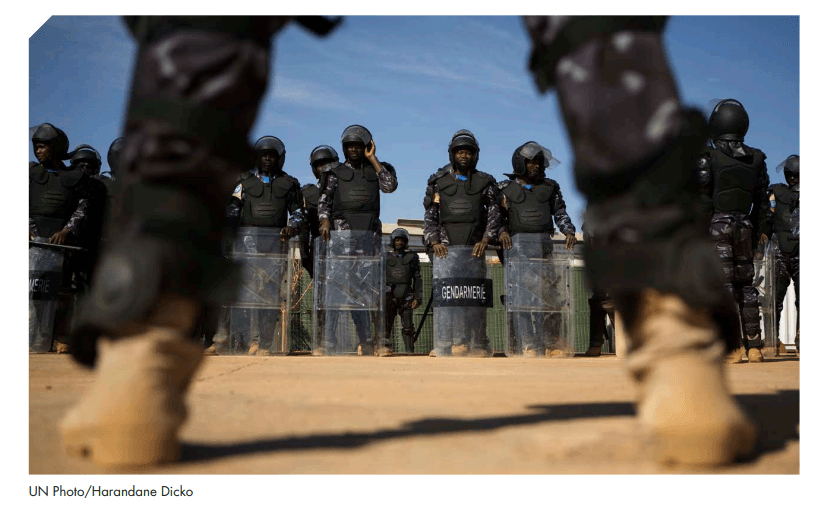
Furthermore, the Office engages with a wide range of security actors, including armed forces, military and paramilitary forces, police services, gendarmeries, intelligence services, border management and control agencies, correctional services, wildlife rangers and other security institutions. It also engages with civilian, military and paramilitary authorities responsible for the management, administration, command, control or oversight of such forces; personnel serving in United Nations peace operations and in peace operations mandated, authorized or conducted by regional and subregional organizations or ad hoc coalitions; private security companies; non-State armed groups; and de facto authorities exercising control over security forces.
Technical Cooperation
Through technical cooperation, OHCHR provides advisory support to help States translate human rights obligations into laws, policies, institutional practices and operational guidance.
Legal & Policy Frameworks
Advisory support on developing and reviewing laws, policies and institutional frameworks governing security forces, in line with international human rights standards.
Capacity-Building & Good Practices
Support to strengthen institutional and personnel capacity of security forces, including through integration of human rights standards into technical training areas, professional standards and accountability practices.
Human Rights in Security Operations
Practical guidance on integrating human rights into planning, conduct and oversight of security operations.
State responsibility
The State remains responsible for ensuring that its security forces comply with its human rights obligations. OHCHR's role is to provide technical and advisory assistance that helps States meet those obligations in practice.
Thematic areas
Four workstreams structure the Hub: facilitating peaceful assemblies, the use of force, investigations, and training of law enforcement officials.
Peaceful Protests
Facilitating and protecting the right to peaceful assembly while safeguarding the rights, safety and security of everyone affected, including law enforcement officials.
Use of Force
Ensuring that any use of force by law enforcement is lawful, necessary, proportionate and accountable, in line with international human rights standards.
Investigations
Conducting human rights-compliant, prompt and effective investigations to ensure accountability, protect victims' rights, and uphold the rule of law.
Training
Integrating human rights principles and standards into technical training and operational practice to strengthen professional law enforcement capacity.
Tools and Resources

Report of the Special Rapporteur on extrajudicial, summary, or arbitrary executions, Morris Tidball-Binz, 22 July 2025 , A/80/214
This report examines the phenomenon of unlawful killings by law enforcement officials and the means for overcoming challenges for their reliable investigation and effective prevention, in the light of international standards for investigating unlawful death and the legal and regulatory framework governing the use of force by law enforcement officials and the protection of the right to life. He also analyses contexts in which law enforcement operations pose a heightened risk of unlawful killings and explores the investigation and prevention of such incidents – including common impediments, the necessary components of effective investigative processes and preventive measures and mechanisms. He identifies examples of good practices from diverse jurisdictions to ensure accountability and rule of law.

Training Guide on Human Rights for Law Enforcement Officials (part of the Human Rights and Law Enforcement Guidance and Training Package) Chapter 21 Law Enforcement and Accountability for Human Rights Violations
The OHCHR Training Guide provides advice on methodology and guidance for trainers developing training activities for LEOs. This chapter provides an overview of the international human rights standards of accountability in law enforcement and explains the respective roles of different national and international actors and mechanisms. The training material is designed to illustrate the importance of LEOs acting in compliance with human rights law and law enforcement agencies establishing structures and processes for dealing efficiently and effectively with allegations of human rights infringements perpetrated by LEOs.
It also provides session outlines based on each chapter in the Manual, which include guidance for trainers and sample session plans, as well as indicative answers to discussion questions and exercises related to the respective chapters.

Training Guide on Human Rights for Law Enforcement Officials (part of the Human Rights and Law Enforcement Guidance and Training Package) Chapter 20 Rights of Law Enforcement Officials
The OHCHR Training Guide provides advice on methodology and guidance for trainers developing training activities for LEOs. This chapter provides an overview of the most fundamental human rights of LEOs as stipulated in core international human rights instruments and explains the imposition of lawful limitations of the exercise of those rights.
It also provides session outlines based on each chapter in the Manual, which include guidance for trainers and sample session plans, as well as indicative answers to discussion questions and exercises related to the respective chapters.

Training Guide on Human Rights for Law Enforcement Officials (part of the Human Rights and Law Enforcement Guidance and Training Package) Chapter 19 Law Enforcement and Human Rights in Command and Control, Management and Organization
The OHCHR Training Guide provides advice on methodology and guidance for trainers developing training activities for LEOs. This chapter provides an overview of the international human rights framework with a particular focus on human rights standards that command and supervisory officials should adhere to, as well as their respective roles and responsibilities. The training material is designed to emphasize the importance of LEOs developing knowledge and skills in supervising and managing a modern law enforcement agency and law enforcement operations in such a way that the human rights of all members of the community, including the LEOs themselves, are adequately respected, protected and fulfilled.
It also provides session outlines based on each chapter in the Manual, which include guidance for trainers and sample session plans, as well as indicative answers to discussion questions and exercises related to the respective chapters.

Training Guide on Human Rights for Law Enforcement Officials (part of the Human Rights and Law Enforcement Guidance and Training Package) Chapter 18 Law Enforcement and Protection and Redress for Victims
The OHCHR Training Guide provides advice on methodology and guidance for trainers developing training activities for LEOs. This chapter provides an overview of international and regional human rights instruments focusing on the rights of victims relevant to law enforcement, and the duties and responsibilities of LEOs to protect, respect and promote the rights of victims.
It also provides session outlines based on each chapter in the Manual, which include guidance for trainers and sample session plans, as well as indicative answers to discussion questions and exercises related to the respective chapters.

Training Guide on Human Rights for Law Enforcement Officials (part of the Human Rights and Law Enforcement Guidance and Training Package) Chapter 17 Law Enforcement and the Human Rights of Persons with Disabilities
The OHCHR Training Guide provides advice on methodology and guidance for trainers developing training activities for LEOs. This chapter provides an overview of international and regional human rights instruments that set out the rights of persons with disabilities relevant to law enforcement. The training material is designed to illustrate the duty of LEOs to protect and respect the human rights of all persons, including those with disabilities. This duty must be applied to all persons, whether they are suspects, victims or witnesses.
It also provides session outlines based on each chapter in the Manual, which include guidance for trainers and sample session plans, as well as indicative answers to discussion questions and exercises related to the respective chapters.

Training Guide on Human Rights for Law Enforcement Officials (part of the Human Rights and Law Enforcement Guidance and Training Package) Chapter 16 Law Enforcement and the Human Rights of Refugees and Internally Displaced Persons
The OHCHR Training Guide provides advice on methodology and guidance for trainers developing training activities for LEOs. This chapter provides an overview of international and regional human rights instruments setting out the rights of refugees, asylum seekers and internally displaced persons (IDPs) relevant to law enforcement, and the duties and responsibilities of LEOs in respecting and protecting those rights.
It also provides session outlines based on each chapter in the Manual, which include guidance for trainers and sample session plans, as well as indicative answers to discussion questions and exercises related to the respective chapters.

Training Guide on Human Rights for Law Enforcement Officials (part of the Human Rights and Law Enforcement Guidance and Training Package) Chapter 15 Law Enforcement and the Human Rights of Migrants
The OHCHR Training Guide provides advice on methodology and guidance for trainers developing training activities for LEOs. This chapter provides an overview of core human rights instruments and standards that set out the rights of all migrants, as well as the duties and responsibilities of LEOs in respecting and protecting these rights.
It also provides session outlines based on each chapter in the Manual, which include guidance for trainers and sample session plans, as well as indicative answers to discussion questions and exercises related to the respective chapters.

Training Guide on Human Rights for Law Enforcement Officials (part of the Human Rights and Law Enforcement Guidance and Training Package) Chapter 14 Law Enforcement and the Human Rights of Minorities
The OHCHR Training Guide provides advice on methodology and guidance for trainers developing training activities for LEOs. This chapter provides an overview of the international and regional instruments relevant to the rights of minorities and focuses on the principles of non-discrimination and responsiveness, as well as the right to effective participation.
It also provides session outlines based on each chapter in the Manual, which include guidance for trainers and sample session plans, as well as indicative answers to discussion questions and exercises related to the respective chapters.

Training Guide on Human Rights for Law Enforcement Officials (part of the Human Rights and Law Enforcement Guidance and Training Package) Chapter 13 Law Enforcement, Human Rights and Gender
The OHCHR Training Guide provides advice on methodology and guidance for trainers developing training activities for LEOs. This chapter provides an overview of international and regional instruments that affirm the rights of women and LGBTI persons, as well as the respective obligations of LEOs to protect and ensure the full enjoyment of those rights and freedoms.
It also provides session outlines based on each chapter in the Manual, which include guidance for trainers and sample session plans, as well as indicative answers to discussion questions and exercises related to the respective chapters.
Events Calendar
Stay informed on upcoming events covering engagements with Security Forces